Radio Free Europe and Radio Liberty
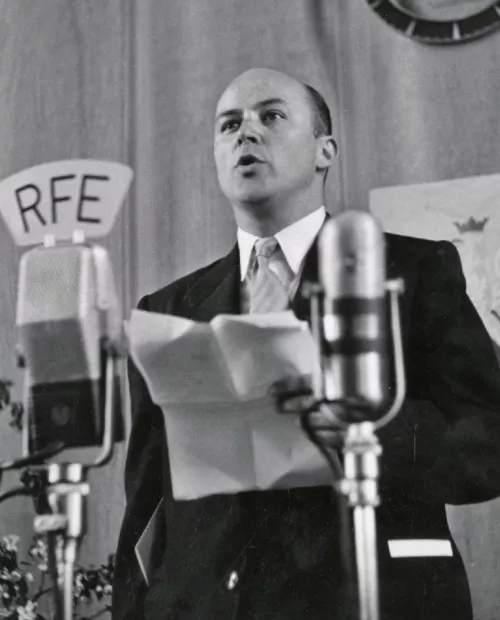
This is a collection of declassified U.S. Government (USG) documents pertaining to Radio Free Europe (RFE) and Radio Liberty (RL) – Radios which were overseen and funded by the Central Intelligence Agency (CIA) until 1971, funded there after by open Congressional appropriation, and merged in 1976 as RFE/RL, Inc. The documents were used as primary sources for A. Ross Johnson's book, Radio Free Europe and Radio Liberty: The CIA Years and Beyond (Woodrow Wilson Center Press and Stanford University Press, 2011). See also CWIHP e-Dossier No. 32 with A Ross Johnson's introduction to the documents, and the related collections Intelligence Operations in the Cold War, and Mass Media and Censorship. (Image, RFE broadcaster Nowak-Jezioraski, 1952)

-
April 30, 1948
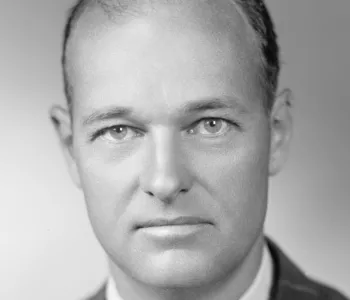
George F. Kennan on Organizing Political Warfare
State Department Polish Planning director George Kennan outlines, in a Policy Planning Staff document for the National Security Council, the idea of a public committee, working closely with the US government, to sponsor various émigré activities
-
February 21, 1949
State Department-Office of Policy Coordination Agreement on Responsibility for Émigrés
George Kennan, State Department official Llewellyn E. Thompson, and Office of Policy Coordination director Frank Wisner agree that influential private citizens organizing the Free Europe Committee (FEC) require approval for the project from Secretary of State Dean Acheson and thereafter responsibility for dealing with East European émigré leaders will shift from State to the FEC.
-
April 19, 1949
Office of Policy Coordination and Free Europe Committee Officials Brief J. Edgar Hoover
Frank Wisner and Free Europe Committee (FEC) president DeWitt C. Poole brief FBI Director J. Edgar Hoover on the FEC project to secure his concurrence and assure him of coordination with the FBI on émigré contacts.
-
September 13, 1949
Kennan Authorizes Russian Émigré Broadcasting Project
George Kennan authorizes Frank Wisner to proceed with a central Russian émigré organization initially focused on émigré welfare and subject to US government policy guidance. Wisner directs Office of Policy Coordination staff in a cover memorandum to proceed with the project.
-
October 04, 1949
Understanding Between Office of Policy Coordination and National Committee for Free Europe
This seminal document reaffirms the mission of the Free Europe Committee (FEC) and outlines the respective authorities and responsibilities of OPC, as agent for the US government, and the FEC, “autonomous… with due regard for the source of its funds. ”
-
November 01, 1949
Office of Policy Coordination, HCFE Broadcasting (Interim Report)
An official from the Department of State, the Office of Policy Coordination updates Frank Wisner on possibilities for providing the Free Europe Committee (FEC) with intelligence reports for use in planned Radio Free Europe broadcasts. He also suggests that Foreign Broadcast Information Bureau monitoring reports of Soviet bloc media can be provided, but only in English translations.
-
April 26, 1950
Recommendations on Utilization of the Russian Emigration
Robert F. Kelley expands the recommendation of his May 3, 1949 memorandum ["Kelley Memorandum on Utilization of Russian Political Émigrés"] that the Office of Policy Coordination encourage the “existing striving of the Russian émigrés to create a central unifying organization” that would organize broadcast to the Soviet Union and be supported through a Free Europe Committee-llike committee in the United States.
-
May 05, 1950
Statement of US Policy Toward Eastern Europe
The Office of Policy Coordination provides the Free Europe Committee with State Department policy guidance dated April 26, 1950, calling for a range of diplomatic and information initiatives, including use of émigrés, but cautioning that broadcasts “should not promise imminent liberation or encourage active revolt.”
-
November 22, 1950
Wisner Update on Radio Free Europe
Frank Wisner reviews RFE broadcasting after 5 months and notes a shift from use of exile leaders “of questionable current value” to “timely news items and commentary.” He foreshadows expansion of broadcast hours and shift of program production to West Germany.
-
August 21, 1951
Office of Policy Coordination History of American Committee for Liberation
Frank Wisner reviews the origins of the Soviet émigré project. He considers AMCOMLIB to be a cover organization without independent authority, notes the difficulty of uniting Soviet émigré groups, yet assumes that an émigré “political center” can organize publishing and broadcasting for the Soviet Union.